
Hear ye, hear ye! The end of Discord is nigh! Plans to roll out worldwide age verification alienate dedicated adult user base! Hear ye, hear ye!
That’s certainly the cry I’ve been hearing going around the internet lately and for good reason. By now I think most of us have seen the headlines: Discord sets everyone’s profiles to “teen” come March, they made pinky promises that your facial scans or ID scans will either stay on your device or be deleted immediately after verification, and then they said some accounts wont have to verify because there’s enough data to indicate the accounts are owned by adults. At that point, you may have just felt a bit icky but were willing to hear them out.
You may have also seen the headlines about a data breach back in October 2025 that leaked the data of 70,000+ ID’s of UK nationals. Or perhaps the one that revealed the planned ID and facial scan verification vendor — Persona — has ties to Peter Thiel – notorious owner of Israeli government security provider Palantir. It’s also likely you’ve heard that in mid-March Discord plans to become a publicly traded company.
There have been calls to cancel your Nitro subs. Definitely keep doing that, especially if you’re month-to-month. People have said to not upload your ID or face to their software. Definitely heed that advice.
Most of all, your communities may be scrambling to figure out what to do and where to go.
Lists have popped up with various different alternatives and it’s confusing to know what to prioritize. Communities will fracture. No one will choose the same platform for one reason or another. It’s getting frustrating out there, and while I can’t promise I have THE solution for you or your community, I have looked into things to help you make sense of it all.
Note: I am personally biased towards FOSS and decentralized software. That said, not all FOSS projects are created equal and they have different target demographics with different business models. I will try to disclose what I know of their community building, what their developers have done, and any funding models. When something is proprietary, I try to mention the financiers of those platforms so that you can make the most informed choice you can.
So, where do YOU go?
I’m going to take a look at Stoat, Zulip, and Fluxer as our primary platforms of concern. Following that, I have some honorable mentions. I didn’t do as deep a dive into those options but they may work best for your community in the end.
As always, my opinion comes attached to all of this and I encourage you to do your own research. I am not a developer by trade but have been in the tech/startup/VC space for much of my career. I am only offering my opinion through that lens.
The Great Alt Debate
First up, I want to mention some commonalities between all three platforms, particularly as it relates to mobile apps and security.
On the security front, none of these options are truly E2EE. Both Stoat and Fluxer have promised some form of E2EE in the future but neither is currently implemented. Fluxer’s roadmap talks of opt-in ephemeral E2EE private messages but states that they do not plan to implement full E2EE for communities. Stoat has, as of right now, not made a comment on any implementation plans.
Zulip does offer E2EE for mobile push notifications, but otherwise offers security through a TLS certificate check. This works similarly to any other https site. The program does allow for self-signed certificates to pass for test builds, but otherwise insists on a current and third-party verified security certificate. Zulip recommends Certbot for this process – a bot that works with Let’s Encrypt, a trusted and known security certificate authority that plenty of major groups use.

On the mobile side of things, only one option has a complete suit of mobile apps. Zulip has both Android and iOS apps that were developed by Flutter – a Google SDK. From my understanding, Flutter works just fine when built for Android but it may have issues on iOS due to the frequent updates Apple pushes. I do not own an iOS device or a Mac device, so I can’t personally verify these claims, I only mention it as something to be aware of.
Fluxer has updated their roadmap recently to say that some Flutter devs reached out to Hampus about building out mobile apps. Flutter is an open source platform that has recently added an AI toolkit that adds either Gemini or Firebase Vertex to an app. I’m unclear if this new toolkit can be used to completely build Flutter apps, but I suspect it’s possible to do so. I mention this for those who are AI-cautious or anti-AI and do not want to be surprised by AI/LLM code or features.
Stoat does have an Android app that works fairly well with some minor hiccups now and again. They did have an iOS app that had been pulled from the store. Currently, in regards to the iOS app, Stoat has had their developer account approved by Apple and are planning to release an app version to TestFlight. In the meantime, PWA is still an option with the old.stoat.chat address. Yes, this option does still have all the old branding of when Stoat was Revolt. To my knowledge all of Stoat’s apps were built by volunteers and do not use Flutter.
With those considerations out of the way, let’s look at the options.
Stoat
| Green Flags | Yellow Flags | Red Flags |
| – Familiar Discord-like UI – Clear and simple privacy policy -Multi-person dev team – Dev chat – Bridging bots – Large user base of queers and furries | – Slow servers – Lack of off-platform updates – Outdated branding in their official documents – Limited AI use | – Clear but broad community guidelines All the inboxes |
Stoat has a very easy-to-get-used-to UI if you’re coming from Discord. It even includes features that are usually locked behind Nitro or that are general quality of life improvements Discord never made.
There are 100 custom emoji slots per server, as well as per server aliases and avatars by default. You can change your username easily as well. Voice chat is present though a bit limited at the moment. I found the drag and drop nature of adding channels to server categories snappy, intuitive, and easy. Threads are missing, but you can still pin things easily. Moderation tools are basic but there are additional bots, just like with Discord, that can provide further help.
The Discover section is great for finding new communities, though the official Stoat server also has a section for you to find servers to join. The most active communities are at the top of the page and just based on that alone, it seems like the userbase skews queer and furry. As both communities make up the backbone of the internet, you better believe this was a selling point for me in Stoat’s favor.
Currently they are going through some growing-pains as they’ve just hit one million users and are dealing with an influx of new users. Expect some service oddities as they adjust. That said, the dev team was great at communicating in their primary server, which you should absolutely join for support and updates as the team is less than stellar about communicating these things out on social media.
You can also always check the server status through their status website: https://status.stoat.chat/
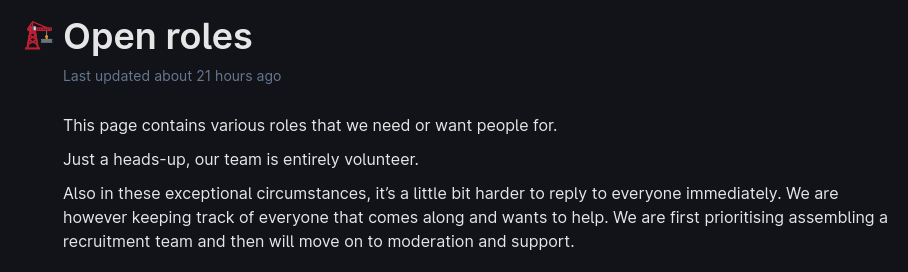
Another growing pain is that their small dev team is in need of some additional support. Not just in terms of server space, they seem to have that well in hand, but for moderation and community management. It seems like this team is having to wear multiple hats at the moment and if you’re up for the task of moderation, I would suggest reaching out to them.
This additional help would likely go a long way to addressing my other yellow and red flags since it seems mostly like these tasks – updating branding in documentation, enforcing community guidelines/investigating violation reports, and managing inboxes – would be best served by volunteer community managers.
As for their AI use: it was three very small commits. All of the AI generated code has been removed. Stoat is not interested in allowing AI/LLM code back into their code-base.
Zulip
| Green Flags | Yellow Flags | Red Flags |
| – Longevity – Clear AI/LLM policy – Full featured free accounts – Supports OSS communities – Responsible disclosure – Hybrid Slack/Discord UI | – Third-party apps – Google program participation | – Only organization accounts – No community guidelines or privacy policy outside of development contribution |
This is an unlikely option to get adopted, but I wanted to highlight it as a potential depending on your community needs.
Zulip is heavily focused on the open-source business market and looks to be an alternative to Teams and Slack, rather than Discord. They’ve been around since 2012 and provide chat services for groups like The Linux Foundation, The Wikimedia Foundation, and even UC San Diego. Even with their focus being more towards large organizations, Zulip does offer fully featured free cloud-based accounts as well as a self-hosted option that unlocks even more features.
One potential limitation of this is that accounts are not individual but organization accounts. So, for each community that you want to join, you would need to make a new account for that community. Community moderation is also, like all the options here, left up to individual communities to monitor and they don’t provide a clear outline for where to take any serious violation to. I’m sure it exists, it just isn’t easy to find.
Though Zulip is feature rich, it does rely on third-party apps for its voice and video calling. They recommend using Jitsi Meet, a privacy focused and encrypted VoIP service. Having used Jitsi back during the pandemic, I can say that it works amazingly well…perhaps even better than Discord calls have ever worked.
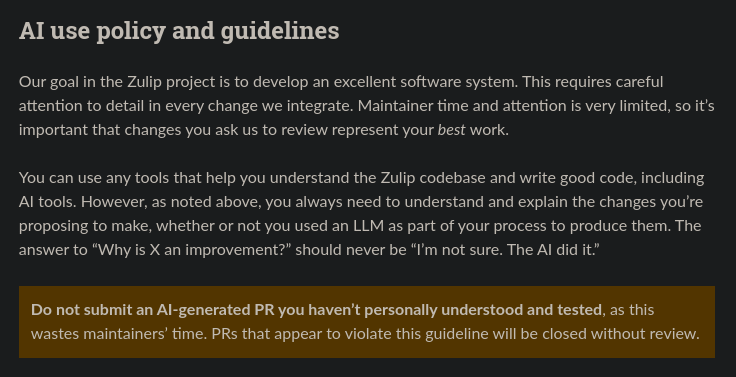
Lastly, Zulip is dedicated to developer mentorship and has taken a hard stance against AI/LLM bots and code being added to their platform. They also participate in Google’s Summer of Code program as a way of helping new developers learn. In their policy they state that you’re free to use AI/LLM in your work, but they will not merge pull requests that can not explain how their requests improve the code. I think this strikes a decent balance that allows for people to use tools available to them while encouraging developing critical thinking skills.
Fluxer
| Green Flags | Yellow Flags | Red Flags |
| – Open source | – Very Discord-like UI – Solo dev – Young github repo – Early monitization – Small communities – Currently not able to be self-hosted | – Use of AI to scale – Ambitious 2026 roadmap – All those inboxes – Dev chat currently locked – Lack of server status info |
I wont hold you and will completely reveal my bias: this project has a lot of trust to earn and it does not do that, for me.
Taking a look at Fluxer, it’s a near 1:1 copy of Discord, even down to the Plutonium package being a cheaper Nitro. It has a lot of the same layout design pieces in the same rounded, friendly buttons and icons. Visually and monetarily, there’s little here that distinguishes it as a brand from Discord and I suspect that has to do with Hampus’ time as a bug hunter for Discord as stated on his LinkedIn profile. It makes me nervous for a variety of reasons.
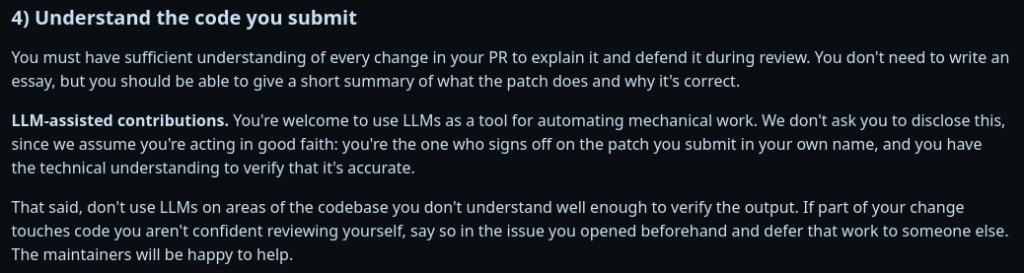
Additionally, the use of AI/LLM to scale and a very young Github (created at the start of 2026) does not inspire confidence either. While Hampus has stated that he’s not interested in continuing to use AI to scale things further, all we have is his words and previous actions to go by. He has not removed the AI generated code, as far as I am aware, and has no additional coding help at the moment.
As for the young Github, it’s not uncommon to merge code before going public. What concerns me is that Hampus claims this project has been in development for nearly five years but there is no available evidence of this. By merging the code before release, we’re unsure of the actual timeline of this project and largely have to accept that he’s telling the truth. In this, I’m giving him the benefit of the doubt, but that still leaves me with concerns.
Pair this with an extremely ambitious 2026 roadmap and I don’t see how Fluxer doesn’t end up using LLM-code again in order to meet expectations. In fact, much like Zulip, Hampus has signaled that he’s fine with code contributions that use AI/LLM assistance so long as the developer behind it knows what it does. However, there is no need to disclose if you’ve used it or not, so I don’t know how contributors will be held accountable for vibecode that breaks the platform outside of a potential reputational hit if they’re using their main github accounts. I would also like to point out that as of the time of this writing, Hampus one one other person are the only maintainers of the code as far as I can see.

While we’re on the subject of the roadmap, let’s talk about the monetization angle. Not only is the roadmap proposing to be a Patreon competitor – which comes with taking a similar percentage of earnings as Patreon does – there is also the fact that Hampus has released a supporter tier that is based entirely on FOMO. I’m speaking of the “Lifetime Visionary” offering that has ended since reaching a total of 1,000 supporters at $300 a piece. That’s some serious money to come into.
Since that time, the Fluxer main server chat has been disabled. This came after days of the server seemingly being unavailable, server uptime being all over the place, and myriad other issues that popped up during a flood of new people. Without a server status page, there’s no way to know if servers are up at any given moment.

Solo dev projects always have a lot to prove and being a Discord alternative is a tall order to fill. There’s a lot of trust to earn, keep, and manage. With all the best, I will be steering clear of this project until it proves itself over a much longer timeline. As it stands, I am highly skeptical of this project making it to the next five year mark.
Others
Now just a quick run-down of some other names you may have heard. This will not be a thorough look into any of them. Please look into them for yourself.
Valour
Proprietary software focused on the WoW crowd. Already asking for money and has $9 million in seed money from AI investors and gaming investors, so it seems like they’re already aware they need to pay back their VC. Likely looking to exit by being bought by Blizzard like Guilded did with Roblox.
Quiet
Seemingly open source, at least I can find their github, not sure if it’s really easy to spin up or not. Uses Tor nodes to connect for messaging, which is done device to device. Can only join one community, which is a big limitation, and there are no video calls/voice calls at the moment. You can, however, create multiple accounts to get around this community limitation. Looks more Slack like than Discord like.
Cabal
Interesting in that they use keys to join servers and is a part of the DAT ecosystem. No media embeds. Everyone who joins is an admin. Hosted locally on device, so no need for a server. Only has a desktop client. Small team of anarcho-punks behind it, it seems, since their community guidelines read that way. No call feature. Haven’t seen what the UI looks like but I suspect it’s very bare-bones.
Cwtch
Another Tor based chat. Doesn’t appear to have really built out servers, they look more like group chats. Not seeing anything about embeds or calls, but you can upload images. Not terrible but seems best for 1:1 and group chats, not really a server. Does have support for everything but iOS.
Session
Uses Libsodium for cryptography and also uses Tor relays. Does have voice and video calls. 10MB file limit. Communities require self-hosting a server, otherwise you’re stuck with basically just a group chat. Haven’t seen the UI itself, they don’t seem to show it off, but it is supported on every major platform.
Element – aka Riot or Vector
Based on Matrix. They’ve had a fair share of issues: keys leaking, hateful content that got them pulled from the Playstore temporarily, and they’re officially banned by the government of India. Each time there’s been a controversy, they’ve changed names. They seem to want to target the business crowd, trying to rival Slack and Teams. All features you’d want are there and they’re on every major platform. There’s a free tier for individual users but it’s unclear to me if there are any feature limitations at that tier. Can be self-hosted though.
And that’s it from me.
Please do your own investigation and use this as a guide to help in that process. May your communities find a home somewhere out there! Stay safe and sane!
Leave a Reply