A review of Foolish Mortals
To start off, I enjoyed Inklingwood’s debut game Foolish Mortals. After having played the demo back at the end of 2024, it was a title that I had been looking forward to, and now in 2026 – only a few months after its release – I’m glad to have finally gotten around to playing it.
If you’re someone who is new or returning to point-and-click adventure games, this is definitely a title to check out. Especially if you grew up playing things like Monkey Island, a title this game has been compared to endlessly at this point. It’s well-deserved too: the tone, atmosphere, and even plot elements are reminiscent.
That said, I did have some notes to pass on. Some ideas. Some critiques to hopefully make their next game even better.
If you haven’t finished the game or plan on playing it yourself at some point, this article is not for you. Look elsewhere. Here be spoilers.
Let’s do some compliment sandwiches. Hope you’re all hungry.
First layer, characters.
There are some characters I absolutely adore.
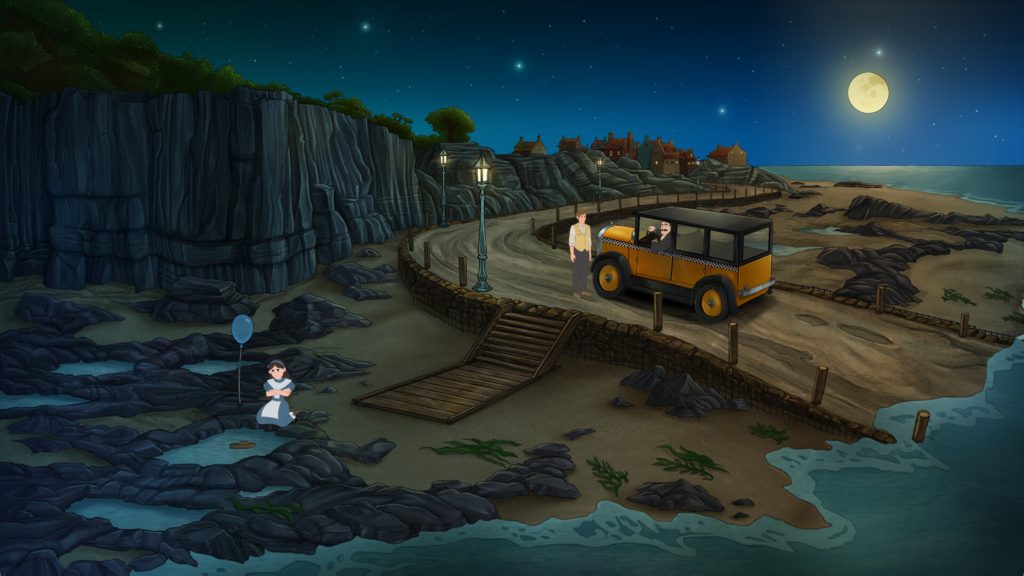
Mallory. Oh, Mallory. May your schemes to take over the world come true.
Each character in this game is endearing for different reasons, even the characters that I personally may not resonate with fully. There’s something real about them even in their tropes. And yes, the game does rely on easy character tropes.
That isn’t inherently a bad thing, to be clear. Tropes are short-hand communication in creative writing and using them isn’t a terrible thing. It also isn’t necessary, in a game like Foolish Mortals, to have complex and trope circumventing characters to convey its story. There are simply too many side characters to even try and make them more complex.
Which is a minor gripe for me with this game. There are simply so many characters that past a certain point I was forgetting names.
“What’s that annoying kid in the box?” I asked chat at one point. “Puck, right?” Chat then swiftly corrected me that his name was Sebastian…and I proceeded to defend my choice of name by saying he was a very Puck-like character.
I think the issue for me was that each character was ultimately single purpose. We were given an introduction to the character, went through a lot of dialogue, and then didn’t engage with them again for awhile. By the time they were important for a puzzle, I had largely forgotten their name or purpose.
There were also characters I had thought would be more important but then largely weren’t. Mallory, for example, was a character I thought would be more important to the story since she’s the only other character capable of seeing and talking to the ghosts. In the end, she’s largely there to hand over a couple of items, do some exposition, and be an amusing little goth girl with a plan to take over the world.
Definitely a fun character, but not nearly as important as I thought she would be.
My critique here is to consolidate character purposes. Having less characters that do more things is overall a good thing. It still allows for tropes to do most of the communicating, but you also get the side benefits of combining those tropes in interesting ways and avoiding overwhelming players with a huge cast. Additionally, it means players do less repeat conversations – another, somewhat minor, gripe I ended up having with the game.
Which is a good point to transition into my next layer: Repetition.
Repetition, like tropes, is perfectly fine. You want some of it so that players become familiar with spaces, characters, and puzzles. That said, it’s a fine line between useful and irritating.
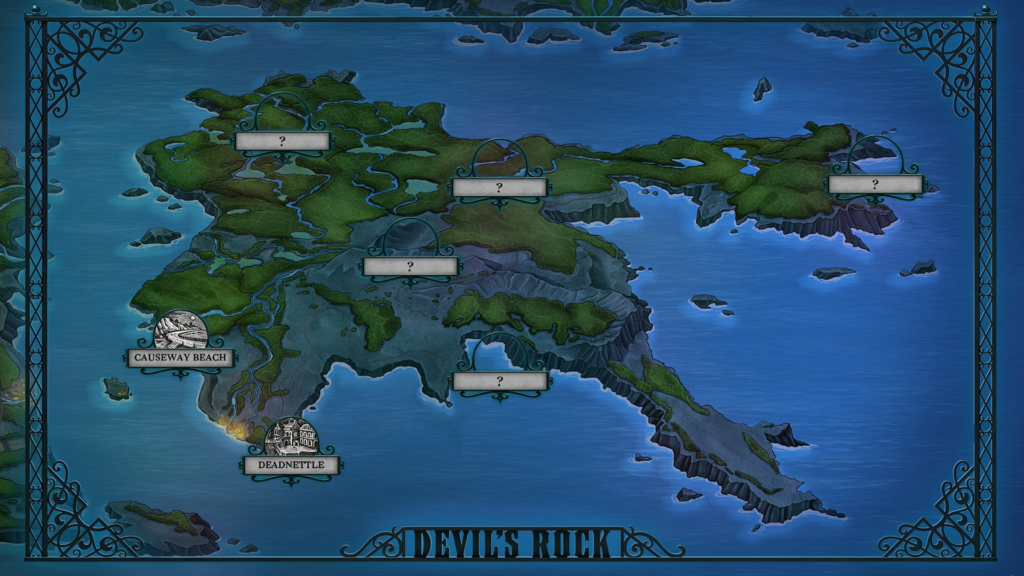
Foolish Mortals has a large map and a lot of characters. It doesn’t feel that way when you look at the overworld map, however. There’s a total of 8 areas the player can freely choose between from the overworld, some of which can only be accessed later in the game. Those locations then each have a series of interconnected environments – anywhere from 2 to 23 scenes at the most.
It’s a lot to explore and unfortunately my experience with this aspect was less than positive.
I don’t mind back-tracking to find puzzle pieces. That’s an expected part of the genre. What was frustrating was the amount of back tracking that ended up happening.
There were areas I visited over and over again because I was so certain they were important to a puzzle. Either they contained an item I needed, or I needed to be there to trigger something, or because an area was closed off and – with a new tool in hand – I needed to see if I could get into a new area. I can’t tell you the amount of time I spent in the mill trying everything to open the office door or seeing what else could be found there.
In the end, the player only visits the mill a couple of times. Once at the start of the game and again at the end. The same was largely true of the swamp – players only visit it in the beginning and then once the Spirit Queen sinks, we never have need to really go back.
All I will say is that at least in the case of the swamp, the sinking of the Spirit Queen was indication enough that we wouldn’t need to go back. With the mill, there’s this mystery about the unopenable door that makes you want to go back and try every combination of things to get it open. Don’t give me a mysterious door, a bunch of tools, and then tell me I can’t open something!
I think there are a few ways around this but the easiest would have been to limit the locations per story part so that players aren’t wasting time in areas that aren’t relevant to their tasks at hand. Either that or remove locations from the map when they’re no longer necessary. There are plenty of options to tackle this issue, but not letting me even interact with a door I can’t even open until I’m on the other side of it would be a good place to start.
This part complements the next layer of my sandwich nicely: these pesky pockets.
The item bloat in this game isn’t nearly as bad as in others, I just want to start off on that. I’ve played games where I’ve had so many items it’s made it impossible to find anything in my pockets. Foolish Mortals thankfully doesn’t fall into the trap of too many items, but it does fall into the trap of making a lot of these items available too early.
An example from my play-through was the firework. It’s something you can easily pick-up in part two when you’re bound to the manor and it’s something you definitely need in part three to solve a puzzle. The issue I had is that…well…when you give someone a firework, that person is going to want to use it to solve everything.
I definitely tried.
At one point, I got so fixated on it being integral to solving the puzzle of getting the lighthouse turned on. It was maddening to try combining it with everything in my pockets only to hear Murphy once again tell me “Nope”. All I wanted was to set that damn flower box on fire and get the captain out of his chair or at least give me the key to his lighthouse!
Why I was so fixated on this being the solution was because I had yet to unlock one of the brother’s rooms. In Part 3, you’re tasked with finding three objects that will help you open the rooms of the three brothers…so you can then go in search of the three keys to unlock the final puzzle of the game. The thing is, you can start these in any order and the game doesn’t guide you much towards any route to start with.
On a map this large, with this huge cast of characters, and with tons of items you need to find…a little bit more leading is important to prevent so much wasted time.
I think it also would have helped with pacing.
My last critique all revolves around pacing and the surprise twist ending. The prologue and part 1 are fairly well paced, well structured, and tidy. I don’t recall running into any issues or needing to back track too much, aside from trying to figure out how to get Doris to let us have some of her feathers for the gris-gris.
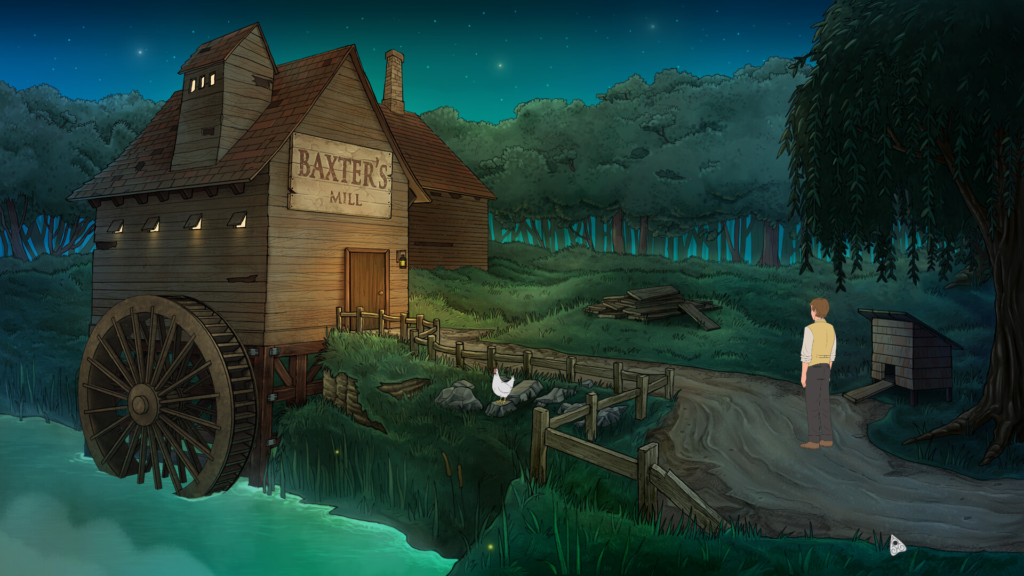
Bless you, Doris, and sorry again for frightening you out of your coop.
Pacing issues really don’t start to show until part 2. Both it and part 3 feel like they take up a lot of the game, with part 3 easily being the vast majority of the time. Part 2 still has the benefit of being a straight-forward fetch-quest style series of puzzles, so that helps to some degree, but it slogs a bit because now you’re having to do a lot of dialogue with a whole new set of characters that you weren’t able to talk with in Part 1. It’s all important information as this is the first time you’re interacting with the manor ghosts, but after awhile I stopped wanting to go through the dialogue trees.
When part 3 arrives, it feels like a weight has been lifted and you’ll finally be able to explore the island…only to then get bogged down in three simultaneous fetch-quests done in two parts each. That’s a total of 6 overarching puzzles the player is tasked with running around to solve. Pockets quickly fill, maps get revisited over and over for new clues, and patience gets tested. At least, mine did a bit.
Once you do finish collecting all the keys and enter the vault where your prize lay, you’re hit with a huge story reveal. Then it’s off to part 4…which is a repeat of part 1. That isn’t inherently bad, but it doesn’t really give enough time to process the big reveal that was just dropped on you because you can solve this part’s puzzle within 20 minutes.
There are no scenes where Murphy is inexplicably hit with memories of his past life. There’s no moments where he fondly recalls Abigail. There isn’t really any time for him to even remark on much of anything other than the immediate.
All of this means that the reveal, at least for me, falls flat. And since the reveal falls flat, the ending falls even more flat.
Chat and I were both surprised when the game just…ended.
The last bit in my complement sandwich here: character and location design.
Even when I couldn’t recall names of characters, I could always recall their design or their trope. The reporter, whose name I forget in an ironic twist since she never really learned Murphy’s name – her alliterations and her Stan Stanman style speaking pattern still live in my head. And Ned, down at the dock? I hope he’s finally nightmare free and catching the good fish.
Visually, the cast is distinct enough and those designs communicate enough about them to make them memorable.
This also holds true for the location design. While I may have found certain areas frustrating at times, at least those areas were pretty to look at. They were full of detail both in the foreground and background of the scenes. So much so that I took the time to click on everything I could to hear Murphy talk about things.
Oh, and the spirit concert? Yea, we had a lot of fun with that segment. Visually just an absolutely fun scene and the music was a goofy bop.
I think all of these things are honestly good issues to have. Inklingwood clearly loved the genre and put their hearts into this game. It’s their first real title, so there’s so much room to grow from here and if this is their starting point? I certainly think it can get a lot more refined from here.
All the pieces are there. This was a fun story, an interesting cast, and is a solid first entry into the point-and-click genre. Even if my critiques make you hesitate to want to play, I still think you should. It’s worth it just to experience the little gems hiding in it.
Who knows…maybe the real treasure of Bellmore Manor isn’t some cursed stone, but are the jokes and scenes we get to experience along the way.
Leave a Reply